3.2 Layer 3
3.2.a Compare routing concepts of EIGRP and OSPF (advanced distance vector vs. link
state, load balancing, path selection, path operations, metrics, and area types)
EIGRP diffusing update algorithm (DUAL)
- Successor route = the best EIGRP path to a destination
- Successor = the next-first hop on the best path
- Feasible distance = The lowest EIGRP distance metric of the best route (“it is feasible that the best route is x”)
- Reported distance = the neighbor’s own metric to a destination
- Feasibility condition = Neighbor RD < current FD
- Passes → path is guaranteed loop-free and can be a feasible successor.
- Fails → EIGRP cannot guarantee from the FC alone that it is loop-free. It does not mean a loop definitely exists.
- Feasible successor = Route that satisfies the feasibility condition (guaranteed loop-free) and therefore can be hot-swapped to in case the successor route goes down
Topology table = contains all the network prefixes advertises in an AS
- Network prefix
- Neighbors that have that prefix
- Metric from each neighbor
- Values used to calculate the FD
Neighbors advertise the entire routing table when forming an adjacency, and only advertise changes
Message types
- 1. Update = respond to requests, transmit routing and reachability info to neighbors
- 2. Request = ask neighbors to get specific info
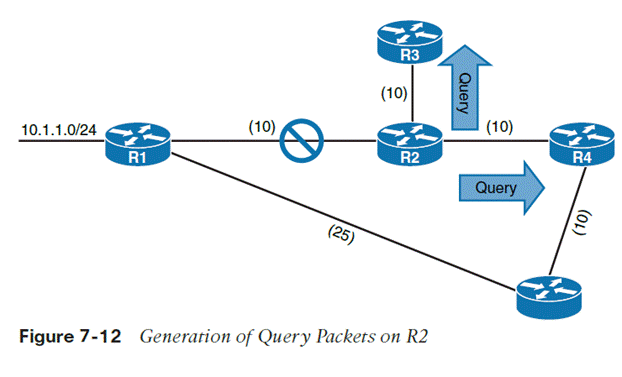
- 3. Query = sent to search other paths during convergence
- 4. Reply = sent in response to query
- 5. Hello = discovery of EIGRP neighbors (absence of hello also detects unavailability)
Metric Calculation
- Bandwidth and delay
- Interface load and reliability
Load balancing
Multiple paths to the same network prefix is ECMP = MULTI PATH
Successor route and feasible successor can be installed at the same time and used to forward traffic, this is unequal cost load balancing
Variance multiplier is a value
Variance value = multiplier * feasible distance
Any feasible successor whose FD is lower than this variance value can also be installed in the routing information base and be used to route traffic, up to a max amount of routes
Traffic share count is ratio of traffic sent across each path
Hello packets, heartbeat to neighbors, hello timer, interval of heartbeat, 5 second default, 60 on T1 interf.
Hold time, time for EIGRP to hold out for for hello packets from neighbor
Default hold time is 3 x hello timer, eg. 5 hello timer = 15 sec hold time, 60×3 = 180 sec on T1 interf or lower
Receiving hello packet restarts hold time, when hold time reaches 0 the neighbor is deemed unreachable and notifies DUAL of topology change
Convergence
When an EIGRP node goes down, every link attached to that node goes down too. Anywhere where that node was part of the route (ie a successor or upstream router), path recomputation must occur
Summarization
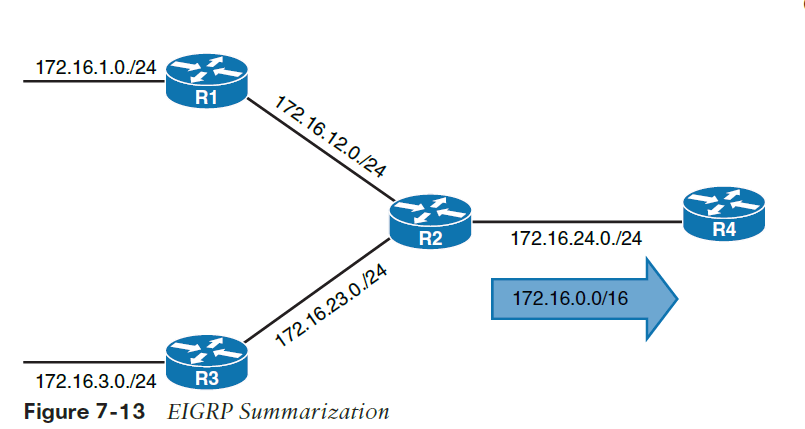
When enabled, component routes are not advertised, and only the summary route is advertised.
It is only advertised when a request for a component network is requested
Configured on a per-interface basis


Leave a comment