This semester, I decided to do something different. Since transferring majors in the Fall 2023, I’ve taken the max course load of 18 credits every semester. The coursework, although not too difficult, was definitely time consuming. My life became nothing but work, school, homework, studying for certifications, and a hobby or two.
Now, I’m in my last semester of college, taking the last four classes I need to graduate. With 6 fewer credits than my usual 18, I decided to fill the void by becoming a research assistant in my college’s physics department.
I had a choice of potential research projects during my application. Measuring PM2.5 in the subway system and predicting ice coverage in the lakes in upstate New York sounded interesting, but not up my alley. Fortunately, one of my previous professors was also looking for a research assistant. Her research focused on weather modeling.
Having worked in a high-performance computing data center before, I knew the nodes were used to perform huge amounts of calculations. But if you had asked me what exactly was running on them, I probably would not have been able to give you a good answer.
After successfully compiling the WRF model and getting meaningful output, I finally have a better idea of what is actually running on these systems. That said, this does not mean I know it all. I have barely scratched the surface of HPC and I still have a great deal to learn. After all, you don’t know what you don’t know.
This post outlines my journey in setting up the WRF model. I hope you find it helpful.
About the model
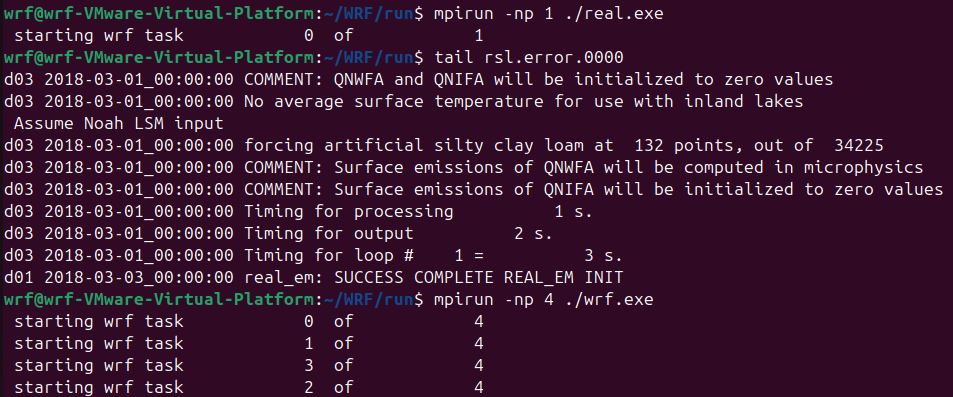
Before I could run anything, I first had to learn more about weather modelling. WRF is a mesoscale numerical weather prediction system developed in 1990s through a joint effort between the United States Air Force, the Naval Research Laboratory, the National Center for Atmospheric Research, and the National Oceanic and Atmospheric Administration.
Numerical weather prediction systems use mathematical equations to model, simulate, and predict conditions of the atmosphere.
I have plenty of Linux experience from my personal projects and work but never have I set up a computationally intensive environment before. The opportunity to both learn about Linux in HPC AND get experience in the real-world application of a subject I love — physics — is what drew me to this research.
The first thing I did was read about HPC.
A Linux distro has powered every single TOP500 supercomputer since 2017.
This post/series is no longer being maintained as of 8/24.


Leave a comment