| 2.3 Describe network virtualization concepts |
2.3.a LISP =WHERE
EID = endpoint ID RLOC = Routing Locator EID + RLOC = who + location on network ITR, ETR, xTR, ingress egress, router doing both Map server = holds the database of mappings Map resolver = answers to queries about where (RLOC) is something (EID) located
2.3.b VXLAN = GET IT THERE
VNI = VXLan Network Identifier, 24 bits, identifies each individual VXLAN, about 16 million of them
VTEP = VXLAN Tunnel EndPoint, the actual device (physical or virtualized) that encapsulates or de-encapsulates the layer 2 data into VXLAN layer 3 packets
Can be software (virtualized, as a v-Switch in hypervisor) or hardware (switch, router, firewall) that supports VXLAN
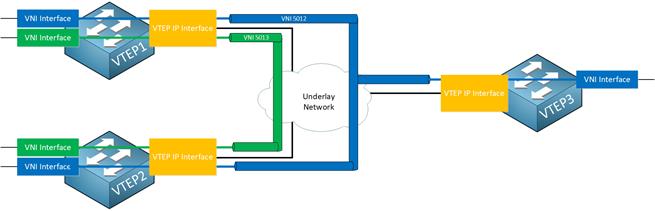
VNI on the layer 2 side, VTEP IP interface on the overlay side
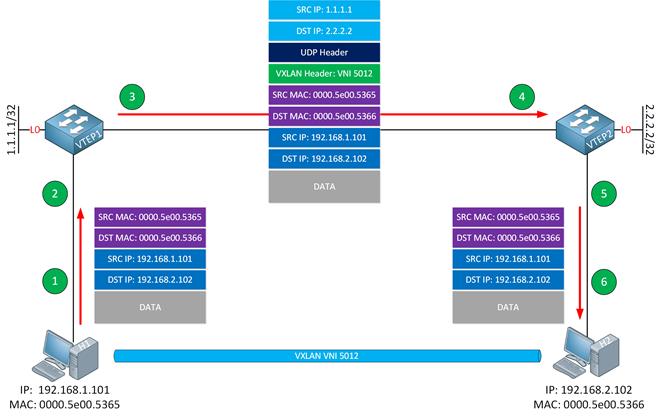
- H1 transmits a frame for H2
- Frame arrives on the VNI of SW1
- There exists a tunnel between H1 and H2 (VNI 5012) so SW1 prepare the frame for the VXLAN tunnel
- Find the mapping of H2’s MAC Address to the what VTEP it’s connected to
- Add the VXLAN header, which contains the VNI
- Add the UDP header (source and destination ports of 4789 and rarely 8472)
- Add the overlay SRC and DST IP addresses
- Send the packet across the underlay
- SW2 receives and de-encapsulates the data
How do VTEPs know the MAC address of the foreign host?
- Essentially each VNI is mapped to a multicast IP address
- Before encapsulation, the VTEP sends an ARP request to the Destination VTEP(specifically, its multicast address)
- It’s transferred over network thru underlay which has routes
- Destination VTEP receives ARP request, notes H1’s MAC address and IP mapping for later, and sends the ARP Request to H2
- H2 replies with ARP Response, and uses the IP-MAC (VTEP, VNI) mapping from the first trip to respond

